Category: Thoughts
QuarkXPress 3.2
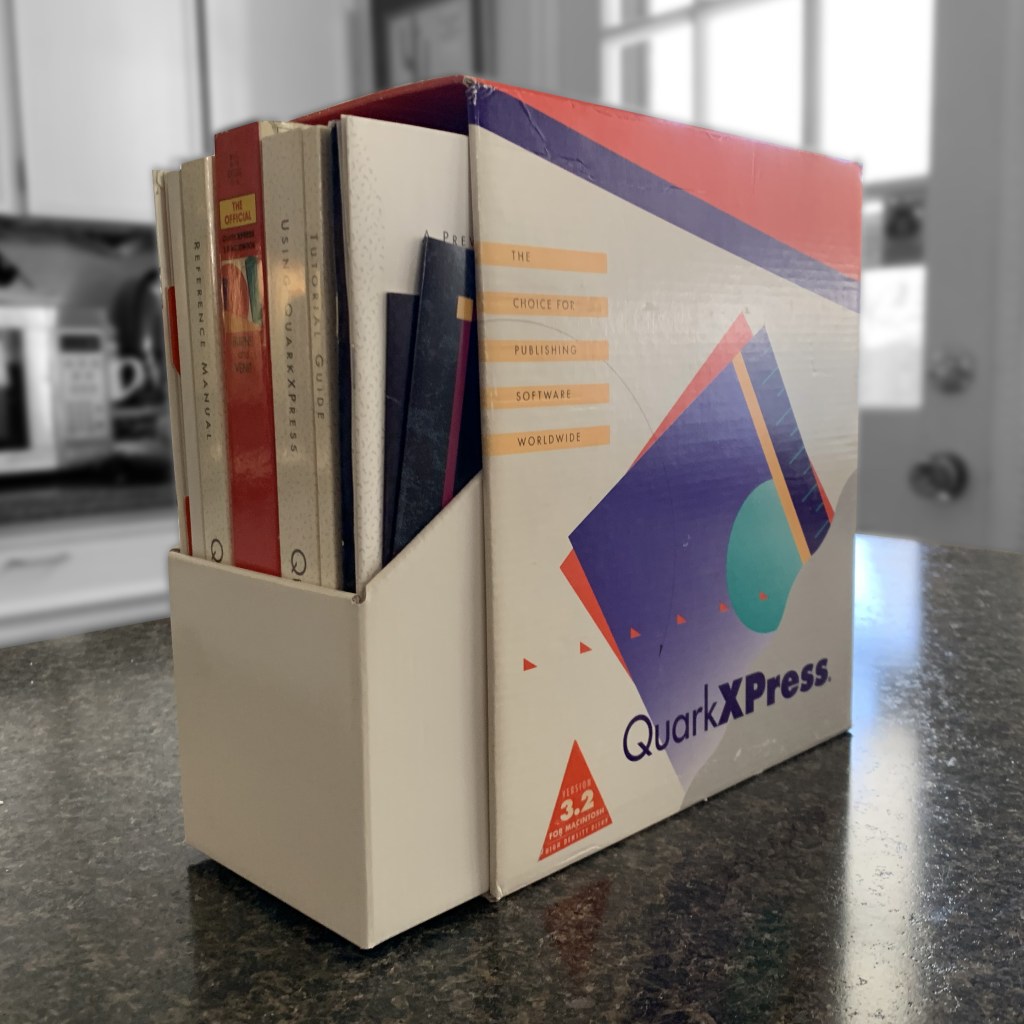
I’m a sedimental kind of guy; Also, I paid six-hundred dollars for this copy of QuarkXPress back in 1993, so I’m probably never going to get rid of it! This was my primary software for years, and actually was worth the price in the end. A great program. Far better than Corel Ventura, which I experienced a few years later.
Coming from manual and electric typewriters when I was a kid, (I found one in a trash pile once and used it until it fell apart!) these programs feel like science fiction and I still appreciate them more than most people do, although it is understandable why everybody takes these amazing programs for granted. Remembering those correction tapes for my typewriters gives me very bad memories! The first time I experienced the ability to just use different fonts, sizes, or spell-check, much less go back and easily edit anything, it was clear that typesetting had changed forever!
Long live InDesign! (And, XPress. Why not?)
Woodstock
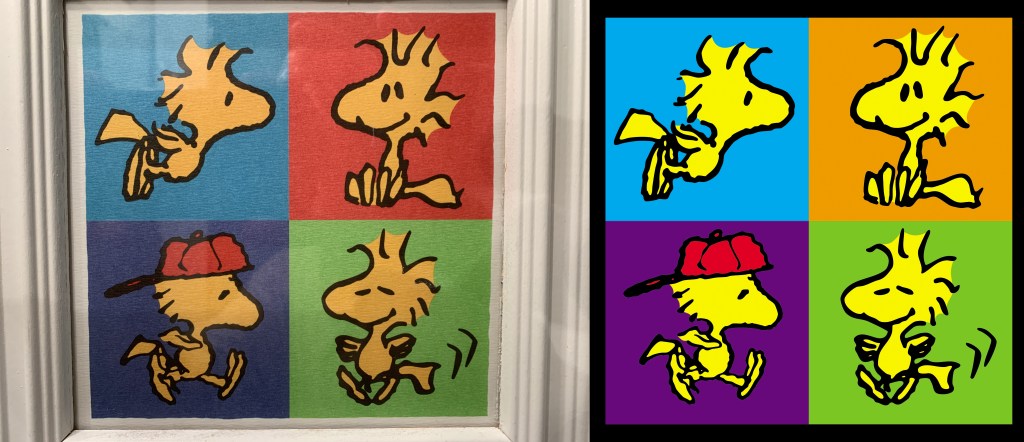
Ten, maybe fifteen years ago, my Mom saw this framed Woodstock at a thrift store, and asked me if we should get it. I knew she liked Woodstock and bought it for her. It has been on a wall at home since then, and every time I see it, I’ve wanted to recreate it in Adobe Illustrator, it is really neat and represents my Mom pretty well. Also, to preserve it, and have the ability to recreate it if necessary. Every house should have Peanuts in it.
I finally got around to doing this, and while it would have been easier to take it out of the frame and scan it, I did the recreation from a simple iPhone photo.
Image Trace was used, but still had to create another layer for the larger yellow areas. Not the most intensive Illustrator project, but absolutely a worthwhile one.
Best Concert Ever
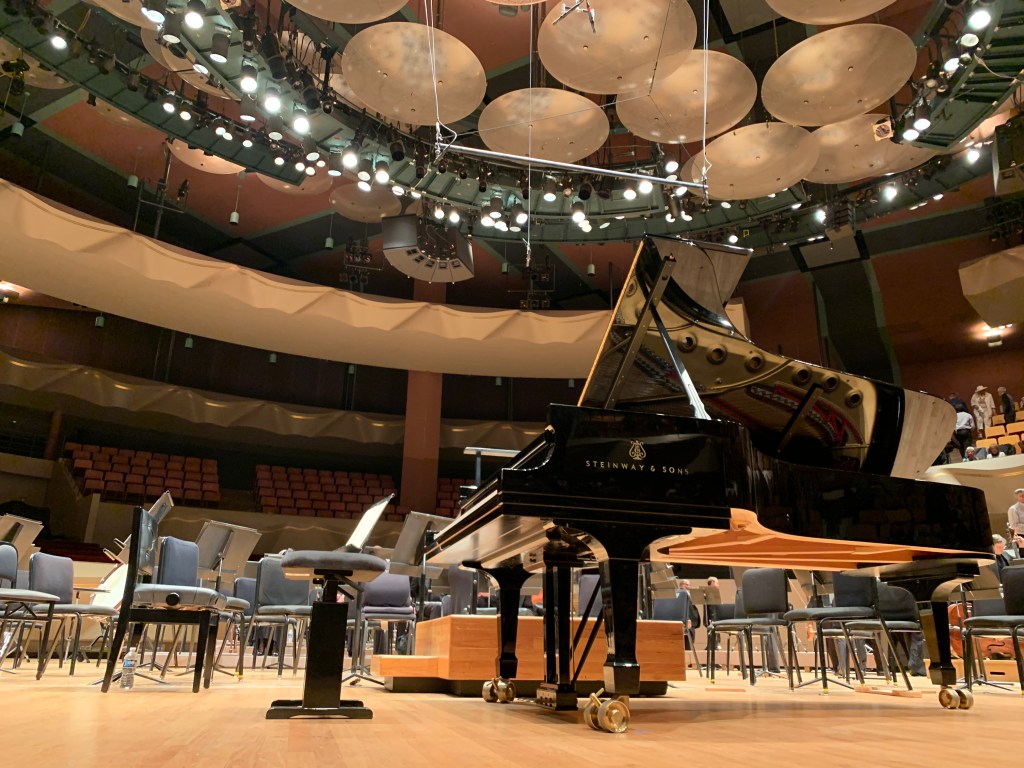
So, my favorite pianist, Hélène Grimaud, is in Denver for a concert. To my knowledge, this is pretty rare, so I got a ticket as soon as I found out. I got a third-row ticket, which in my experience hadn’t been a thing I could get before. Third row, center, an aisle seat.
The day starts off pretty good, as I took it off from work and slept in.
Then, Hélène’s latest release that I had pre-ordered months ago, showed up. On the day I’m going to her concert, the only concert I’ll ever get to see her at.
So, I get to Boettcher Concert Hall early as recommended by the Colorado Symphony web site, and I have a nice conversation with two other earlybirds, who as it turns out, drove from the east coast just for this concert. I’m not the only Grimaud fan!
I get in, go to my seat, and I had to triple-check it, and then check with an usher, because my seat turned out to be first row. The two rows in front of me were covered by the stage, as the stage can be brought it a bit for other kinds of performances. On the online seating chart, those rows were listed as being sold out, but in reality, they just didn’t exist for this concert. I’m front row!
The concert started out with the Star Spangled Banner, of all things, and that was totally unexpected. The conductor, Peter Oundjian, said a few words, and then caught everybody but the orchestra off guard by jumping into the anthem. People didn’t even realize they should stand up for the first fifteen seconds or so! But it was great, it sounded good, and a nice way to start things off. I really enjoyed that!
So the first piece was not Hélène playing the Brahms Concerto, but rather the orchestra playing a newly written piece by a modern composer. (Carlos Simon: Fate Now Conquers) Most modern composers I’ve heard are hit-and-miss, so I wasn’t really thinking it would be any good, but it was really good. I genuinely liked it a lot! The entire piece is great, but there is a cello solo (for the section) that sealed the deal.

That’s something I’ve taken away from a lot of classical concerts, they’ll introduce one to some great pieces one might not ever hear before by piggy-backing them to the main event. I was introduced to “The Great” Symphony, and Shostakovich’s Eleventh Symphony this way, among others.
And then I realized; where’s the piano? Because I was so close, and sitting so low, I could only see the first row or two of the orchestra. Luckily, right when I was starting to panic a little bit, they roll it out. But here’s the thing: I didn’t just have a first row seat, which could have been to my right, where I’d be able to see the piano and no Hélène, or to my left, where I just see her from her back, so, no hands, but she was literally ten feet in front of me. Part of watching a piano concert is seeing the hands, and I had the perfect spot. It was like the concert was just for me! The two seats next to me, which, according to the online seating chart, were sold… those people never showed up. So I had the aisle seat, front row, Hélène ten feet in front of me, and nobody on the right of me. Just perfect!
And, since I’ve heard the recorded versions of this many, many times, hearing her play it live was amazing. I had no appreciation for what those hands have to do on those keys.
I couldn’t take any photos or videos, as the rules state that there is no flash photography (no flash is needed there anyway) and if the conductor is on stage, no phone cameras. So, I have some shots of the setup and the warmup, but that is it. And that is okay, it’s nice to not see phones everywhere. It’s about enjoying the live music. But I wish I could have taken a few shots though. It’s what I do.
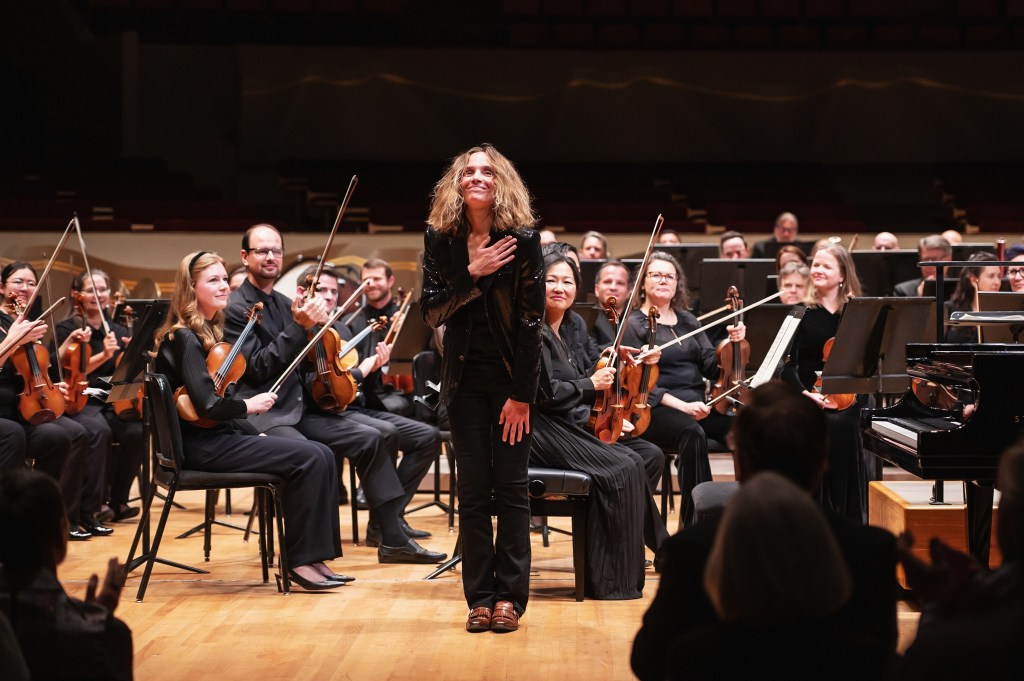
I won’t get into what the Brahms concerto is like, why it is so great, why Hélène is such a great pianist, etc. That is something that has to be experienced to be accurately understood. The program they handed out tries to describe the pieces and how they sound and they make a good go of it. But of course, it’s better to hear these works and not just read about them.
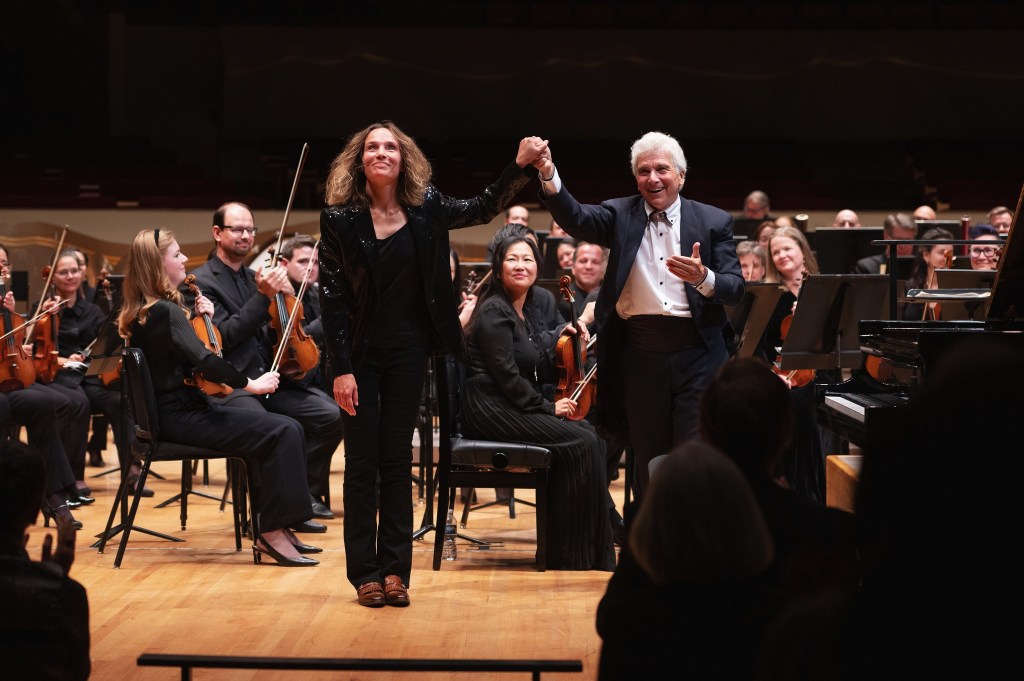
After the concerto was done, there was the intermission. Time had already gone by faster than I had anticipated. The symphony starts up Beethoven’s Fifth (the best symphony ever, except maybe for the Ninth. If you don’t know the difference, that is a shame!)
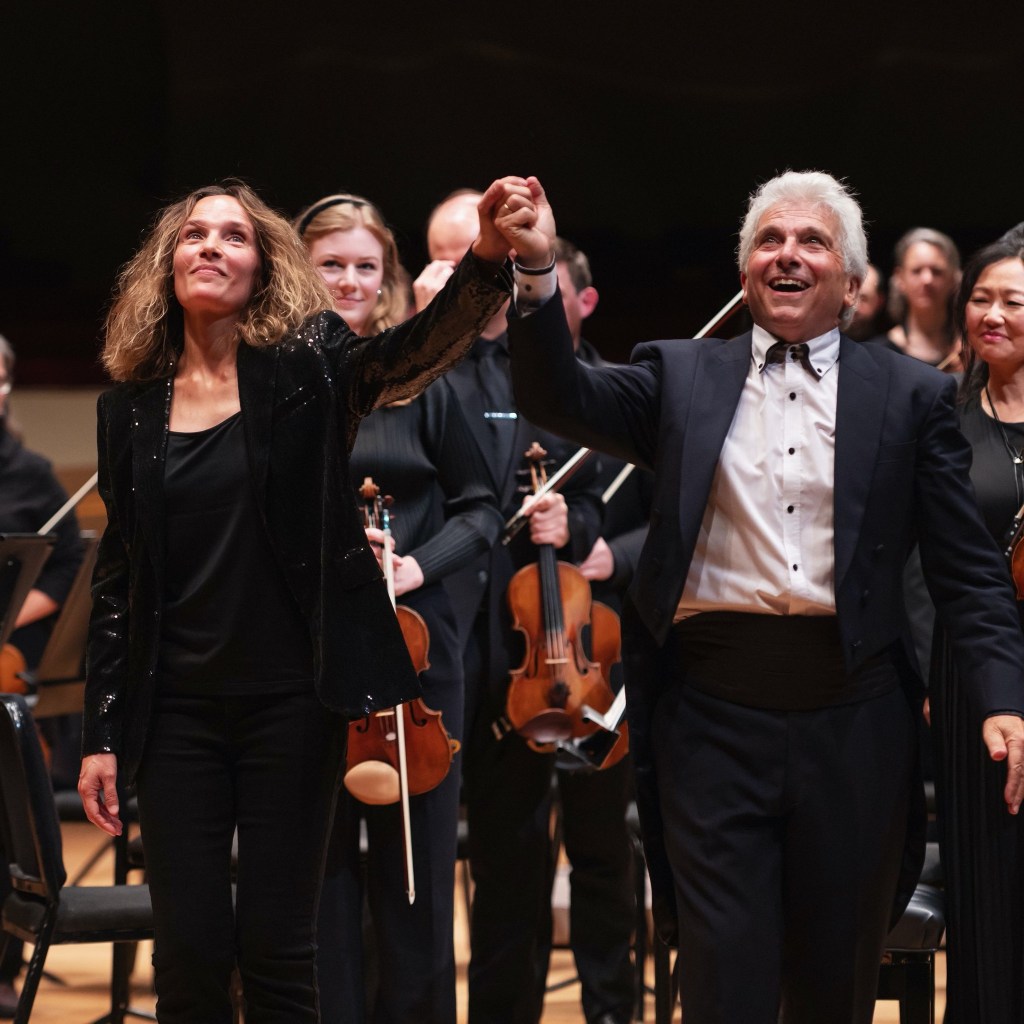
So, the Fifth Symphony, front row. Amazing. And I really do like this conductor, whereas going in, I didn’t really care who it was!
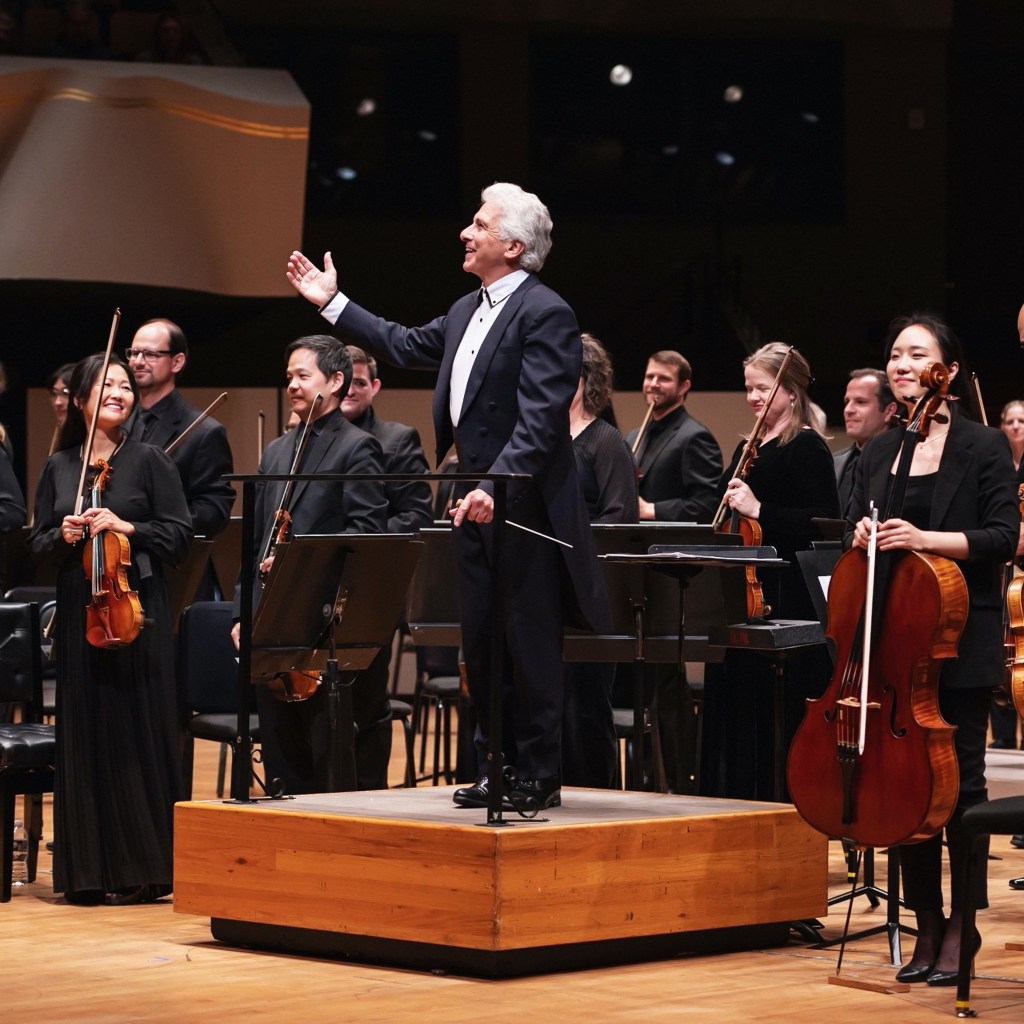
So, after all of that, I stuck around for the question-and-answer with Peter Oundjian and Hélène. (front row, again!) And this is one of the great things about Hélène Grimaud, the way she talks about music, or just anything. She is very thoughtful, and insightful. Every time I see some mainstream music artist talk about what they do, it really contrasts things for me.
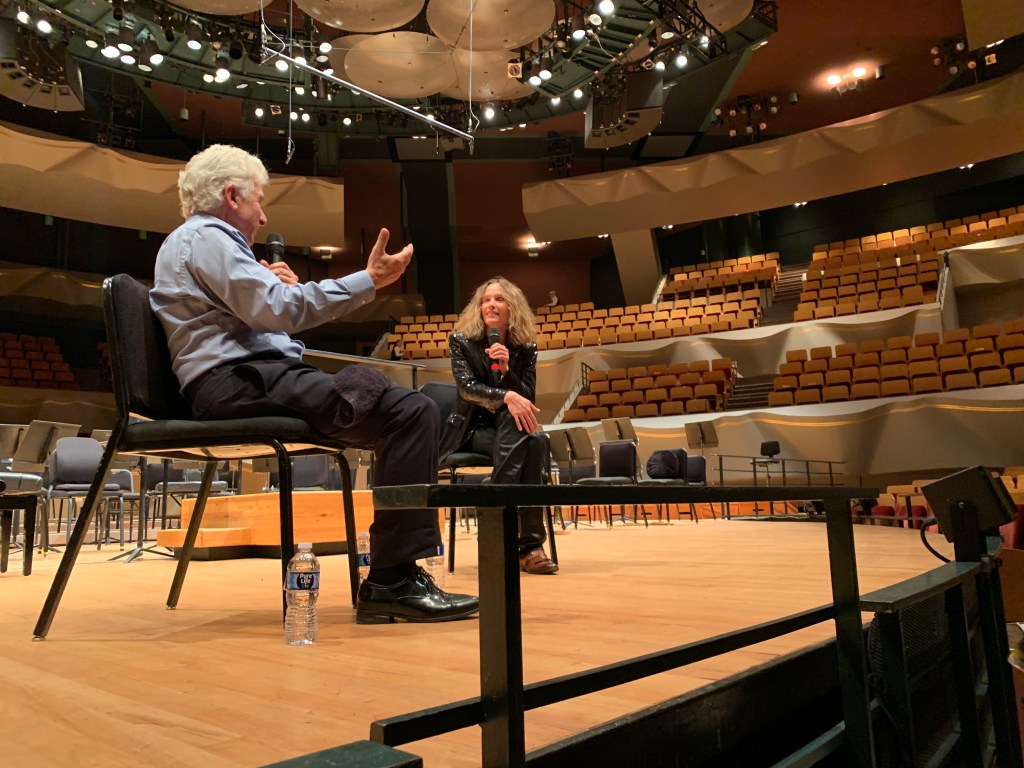
And there were some funny things in the question and answer session too, such as the question about the way Hélène sees colors (synesthesia) when certain sounds occur, I forget the rest of the context, but Oundjian said something when Hélène mentioned the color orange, he piped up and said something about a part of the concerto that was in F-Sharp, must have been written about the Broncos. I wish I had recorded this! But also, the way she answered the question, one just has to hear it. Eloquence. I don’t have that, and most people don’t. Now that I think about it, it’s kind of rare, which is why it stands out to me.
I had some questions lined up, but one of the early questions from someone else was really, really good, and my questions were definitely nowhere near that caliber. For the good of everybody, I just stayed quiet, because most of the questions were actually interesting. Sometimes, it’s best to just listen!
I got to talk that couple I met before the concert as I left, they are going again tomorrow, as they had a hotel room across the street. Lucky!
This is definitely the best concert of my life. A can’t think of a concert that could possibly be better than what I experienced tonight. Any concert at Boettcher is going to be really good, especially if they do works by the right composers. The talent of the symphony and the featured artists is never going to disappoint. But I’m not likely to get a seat like that, in front of my number-one favorite artist ever, under those conditions and with those pieces being played.

Watch a War Movie.
“When good people see evil raise its head anywhere in the world, and do nothing about it, and become indifferent to it, that’s the consequence, because evil, conquers. Evil triumphs.”
– Survivor of the holocaust, from this video.
I get asked the question of “How can you like that movie?” when I talk about something I’ve seen lately, such as “All Quiet on the Western Front”, or “1917”.
I never get my point across very well, in part because I am always confused as to why someone wouldn’t want to see these attempts to recreate the past in a way that we can today get a view of what it might have been like to go through these events.
Anybody who reads history for a decent amount of time will see that we actually don’t know that much about the past, and of course, the further back we go, the less recorded history there is. There is far more history lost to time, than there is recorded. When you see something on television about how amazing it is that the Pyramids in Egypt were built, or some other puzzling ancient accomplishment, that is just a really obvious example of how little history has been preserved.
Actual recording of history didn’t become much of a thing until the time of Henry VIII, due to logistics, social and physical. And as far as humankind is concerned, that is relatively recent.
I saw these “Man-on-the-street” interviews in Hiroshima on the anniversary of the bomb dropped there in 1945. Actual citizens of that city had no idea what the significance of that day was.
Most Americans are the same way. Zero understanding of important events, so many of them in regard to war. And a total avoidance of anything, book or film, that might remind them of such.
The most difficult book I’ve ever read, “Hitler’s Willing Executioners“, gets detailed into the reasons of how one of, if not the most advanced society in Europe at the time, could descend into such a barbaric state. To think that we, today, are automatically so much better than the Germans of the early 20th century is total hubris. It very much could happen again, and in our country. It comes at us in other ways which would hide the obvious, like it did in Germany. Which is why avoiding anything resembling something that could possibly educate us about our past, is a mistake.
How are we as a society going to avoid wars and holocausts if we don’t understand how they happen? That is what ignorance is, and in this case, completely willing ignorance. Because there’s another popcorn movie or television show to go watch. And I like those too, of course. But historical topics are just as, if not more interesting, because they are based on actual people and events that can be looked into, there is more depth to the topic of the film. So much to be learned, and most of it very interesting.
Wars aren’t just battles and horrific events. They are logistics, politics, psychology, humanity, examples of selfishness and selflessness, strategy, and on and on. To just avoid the topic because there was the obvious horror of it, is not a good thing.
There is a guy who lives near us who fought on Iwo Jima. He’s in his 90’s. I’ve talked to him a little bit, and it was fascinating. I didn’t run away because it might be about war. I have to think he’s really disappointed that most people couldn’t name ten battles, places, events, or people, related to that massive event he experienced. Something that made the world we live in today.
Go watch a war movie. Then read about it. It’s fascinating and worthwhile.
Links • Geopolitics, History, and Current Conflicts
Here are the sources I follow daily for information and analysis of Geopolitics, history and current conflicts:
Preston Stewart – US Army veteran with a focus on both current and historical topics.
Ryan McBeth – Army veteran with incredible analysis not found in normal media, debunking common assumptions.
Andrew Bustamante – Former CIA operative who offers insight nobody else can provide.
Combat Veteran Reacts – American combat vet with news and current map analysis.
Artur Rehi – An Estonian soldier/YouTuber with great insight into the Russo-Ukraine war.
Anders Puck Nielsen – Military analyst based in Denmark.
James Ker-Linsay – Professor from the University of Kent, who holds a PhD in International Conflict Analysis.
Konstantin Kisin – Russian-English author and podcaster.
Patrick Bet-David – Host of the Valuetainment podcast on YouTube, focusing on the fundamentals of entrepreneurship and capitalism.
TIKhistory – TIKhistory is a YouTuber who creates detailed and accurate historical documentaries that aim to put TV documentaries to shame. With a focus on World War 2 and similar topics, TIK seeks to dispel the myths and distortions of the past so that we can learn from it and not make the same mistakes again.
Binkov’s Battlegrounds – Ever wondered how any given two countries would fare in a war? Or how certain weapon systems fared against each other? Or simply how missiles or stealth or anything military related actually works? Binkov gives you those answers!
Mark Felton – Mark Felton Productions is a STRICTLY NON-POLITICAL history channel presenting films by leading military historian and author Dr. Mark Felton on a variety of fascinating historical subjects, with particular focus on WWII and the Cold War.
Paul Warburg – He has replaced Peter Zeihan for me, in providing YouTube geopolitics discussed on long walks with a GoPro.
Jack Carr – Former Navy SEAL sniper and #1 New York Times bestselling author of The Terminal List series and the Danger Close podcast.
Shawn Ryan – A former SEAL, and hosts a great conversational podcast: The episode he did with the World War II flamethrower vet was the best I’ve heard.
MilitaryLand.net – Daily details regarding the war in Ukraine.
Jake Broe – Air Force Veteran and Pro-Ukranian YouTuber.
Denys Davydov – Ukrainian pilot with news and current map analysis.
The Russian Dude – Daily updates on Russian-Ukrainian war. 9-12 minute summaries of all the major events that happened that day, including footage from Ukraine.
Vlad Vexler – Moral philosopher with deep analysis on the Ukraine war and associated topics.
NFKRZ – A Russian YouTuber who has fled Russia, and vlogs about current events regarding Russia and life after leaving it.
Natasha’s Adventures – Natasha is from the Far East, right next to China and Japan, but fled Russia recently. Interesting long-form videos on life in Russia and beyond.
IN THE DOGHOUSE:
Zeihan on Geopolitics – Geopolitical strategist with insight on global issues. Many of his predictions are spoken with great confidence, but don’t come to pass.
Neil deGrasse Tyson – I can’t say whether his astrophysics is faulty; but once he ventures out of his realm of expertise, he loses scientific analysis and only believes things through an emotional lens. On one scientific topic that he was losing an argument on, his defense was, and I quote: “Why do you care! Why do you care! Why do you care!” That kind of passionate view on a scientific topic destroyed his credibility, in my view, and makes him more of the “Bill Nye, the Science Guy” of astrophysics.
Finished Re-Reading All Vince Flynn Books!
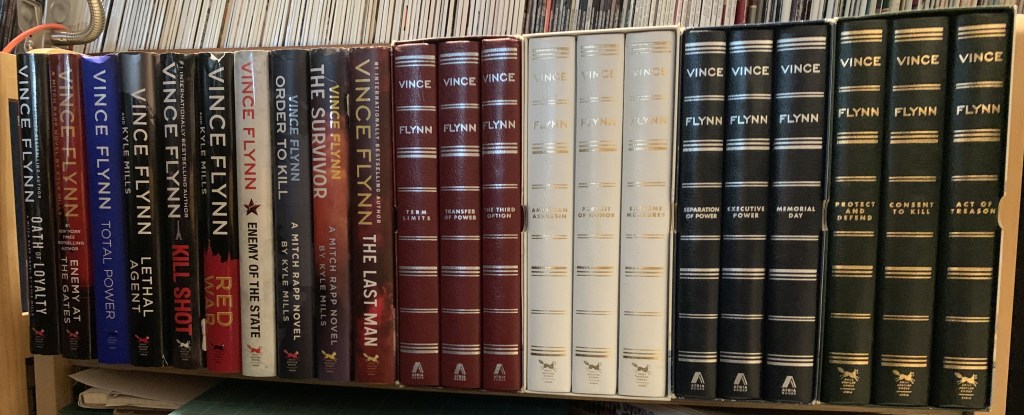
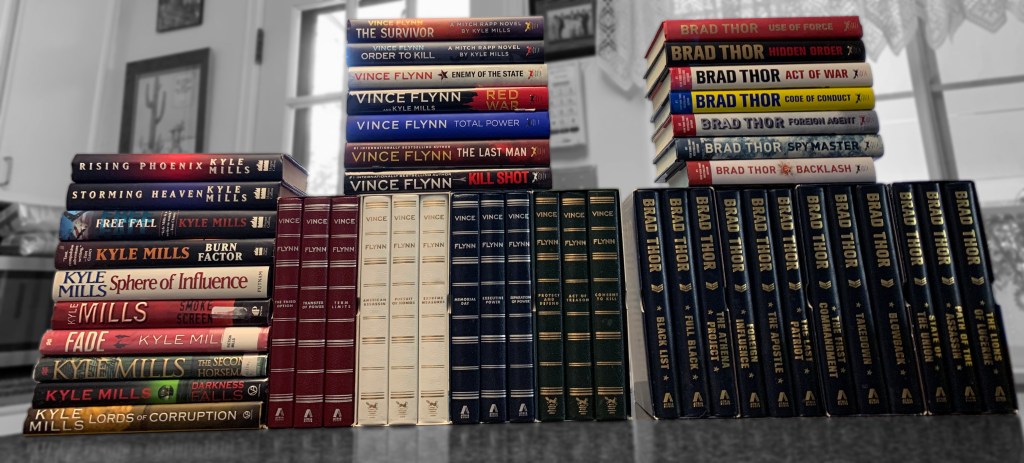
Just finished all twenty-one Vince Flynn books! (The last eight were written by Kyle Mills.) That only took thirteen months, with breaks in every book or two. I actually bought the latest one brand new, something I never do (except for the Collectors Editions) because it was released right as I finished book number twenty.
So, now I’m starting the twenty-one Brad Thor books, and then I’ll read the ten Kyle Mills books (that he wrote before taking on the Vince Flynn series after Flynn passed away from cancer.)
One of the interesting things about these books is the research that goes into them; Flynn was investigated by the CIA at one point because his books went into things he wasn’t supposed to know; I think it was Thor, who actually went to Afghanistan, embedded with some troops, so that he could accurately write one of his books. And, Mills posted last year about how things he’s been writing about has been coming to pass, which is terrifying since Total Power was about how quickly the world as we know it goes away if the power grid is suddenly gone, and how inept the government is in preventing and dealing with it. Within weeks, millions would/will be dead. It is a pretty simple catastrophe, which doesn’t take much to understand. We all live by a thread.
I Finally Did It.
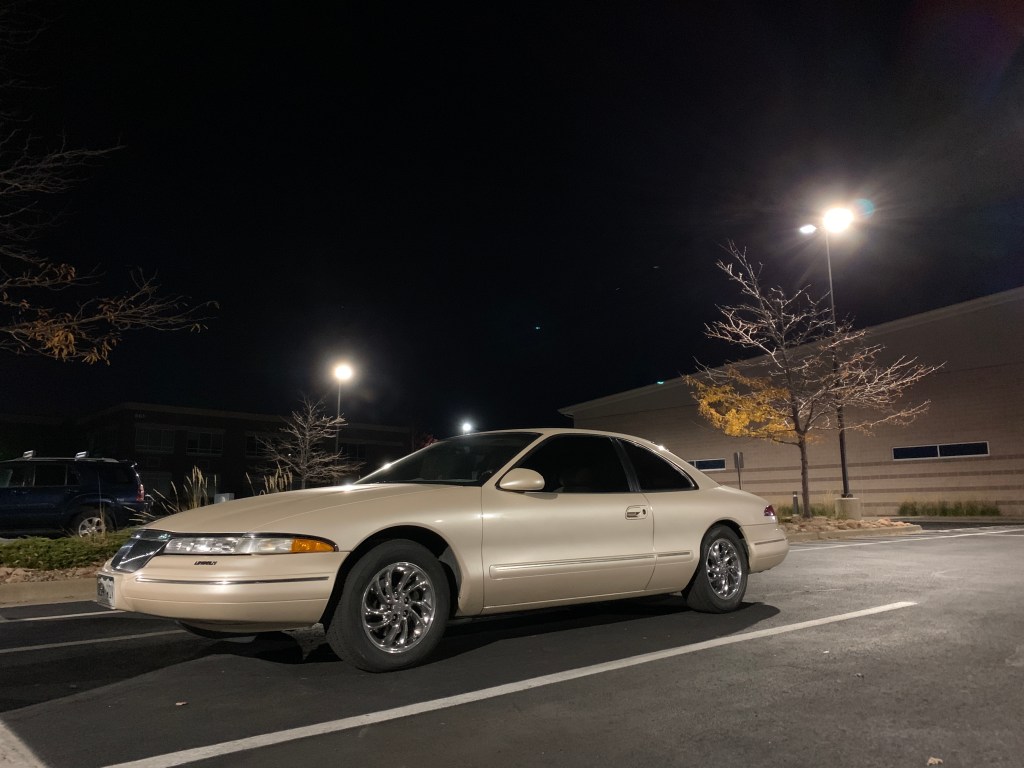
First time ever: I took my garage-stored car, that has never been rained on since I took ownership back in what, 2014? That I never drive if I don’t have to for fear of… everything… I took it to the Ice Ranch. The longest drive ever with this vehicle, for me. When I bought it, I declared that I’d never have my hockey gear in this fine automobile, but upon watching some videos on the perils of allowing a car to sit too long, it was mentioned that if a car isn’t driven specifically on the highway, to get true hot/cold action on the engine, big problems will evolve. So, it was for the good of the car. I picked a late-night game in good weather, and the long drive home on C-470 was wonderful! Especially the newly remodeled parts to the south. Boy was I careful with my big bag and sticks in this car, they weren’t in it any longer than necessary!
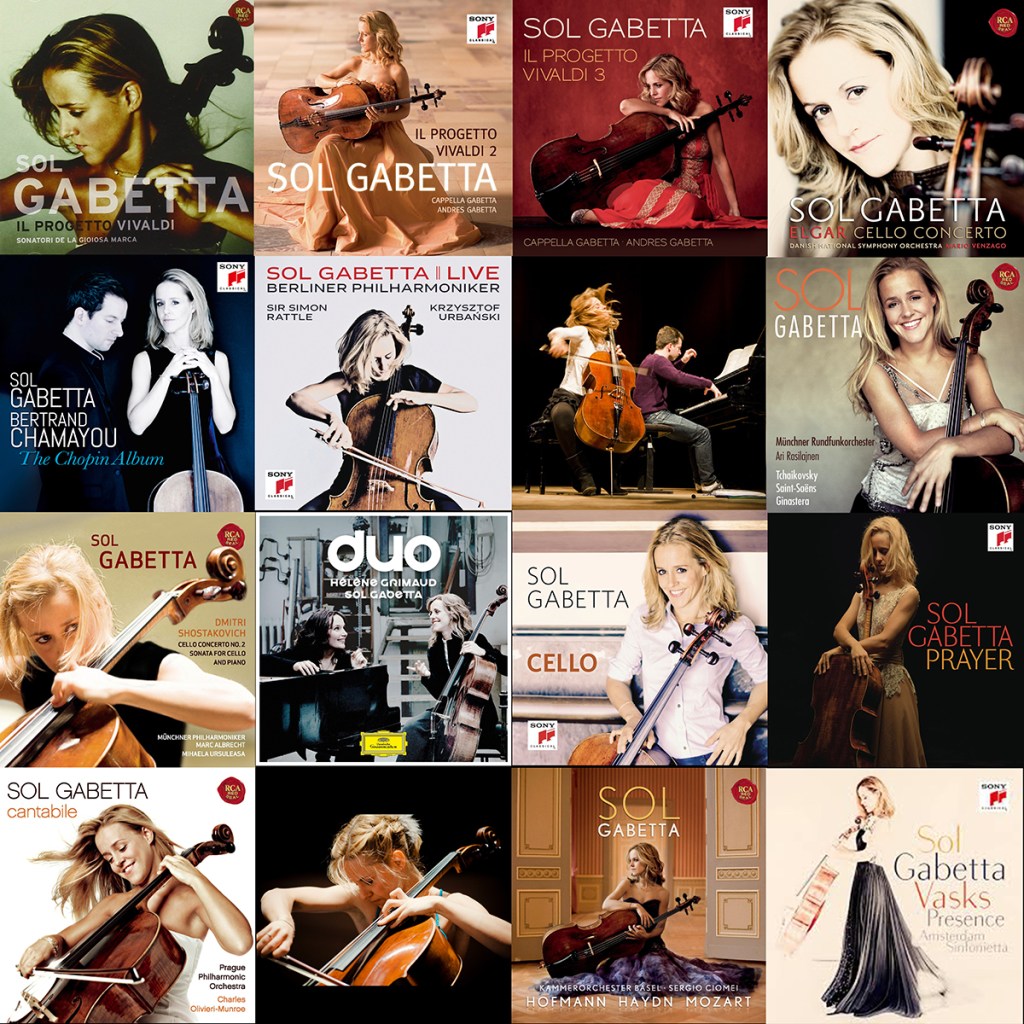
My favorite cellist…
Finally figured out why Facebook moderated me…
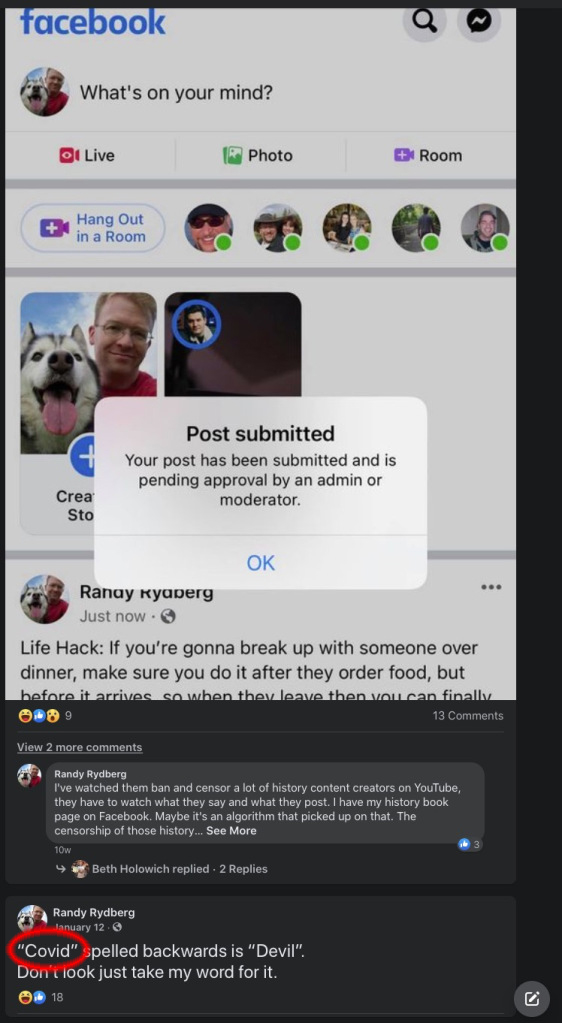
I’ve heard about this, but it didn’t register until now; I used the word “Covid”.
That was my transgression. It was automatically picked up for an admin or moderator to approve.
Facebook censors people with views they don’t like, while they themselves publish whatever they want on the topic of Covid.
So, if I’m not buying into the group-think on this, if I’m not ‘thinking correctly’ on this issue, I’ll be blocked from posting, while they can voice whatever they want.
I have been on Facebook for eleven years, all without a single out-of-the-blue moderation such as this. I never posted anything political. Then this happened when I mentioned the very political and contentious topic of Covid in a joke.
Also, by sheer coincidence, this happened the same week Trump and others were banned from social media outlets, the same week Parlor was shut down.
This is not okay. This is not a good direction for us to be going in.
This is exactly the kind of thing that happens in authoritarianism; control over thoughts and minds, control over all information. No other opinions or data are allowed. Hitler, Stalin, and all of the other regimes did this kind of thing; promote the one, ‘correct’ view; all others are to be suppressed.
If you disagree, by all means let’s have a conversation about it. I’d love to hear how I’m wrong about this. I won’t ‘moderate’ your views.
Covid is something we should all be discussing and looking at from all angles; Facebook only wants one single view with no thought process involved.
Just believe everything they feed you without thinking, and you can post whatever you want.
 randyrydberg.org